

Flashback Friday: Wolfmother by Wolfmother
A Look Back at the Band's Self-titled Debut 20 Years after it's US Release
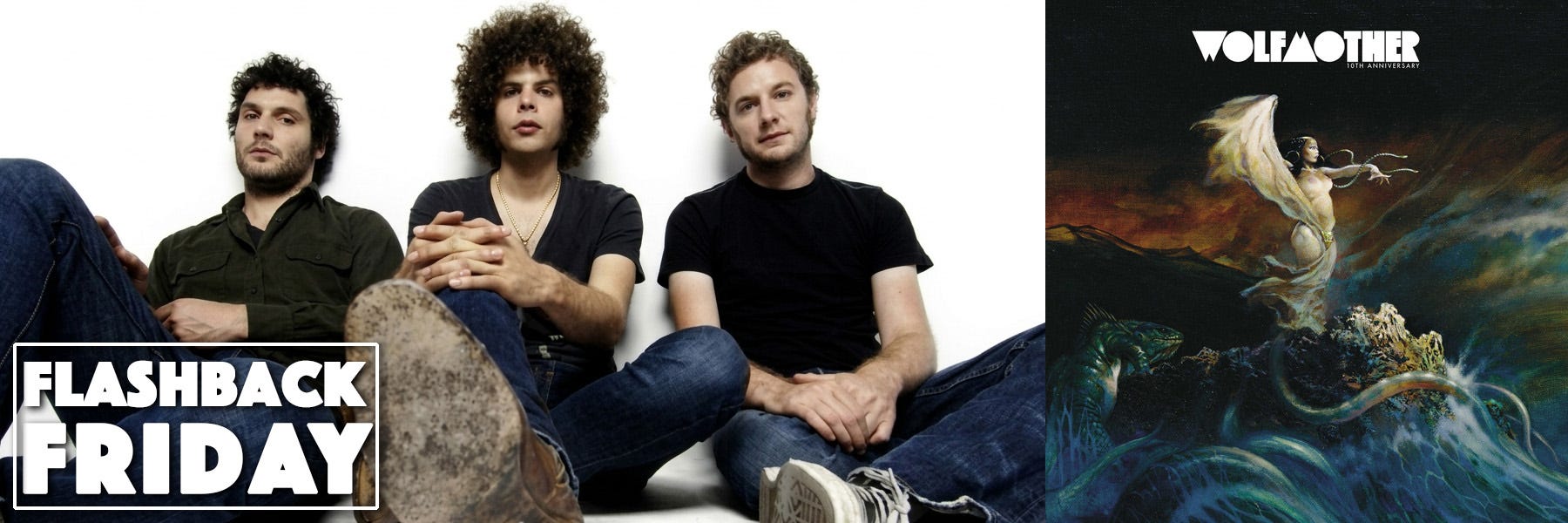
In 2006, a trio from Sydney, Australia, emerged in the US with a sound so brazenly “retro” that it felt less like a debut and more like a lost master tape from 1972. Twenty years later, Wolfmother’s self-titled debut stands as a fascinating artifact—a record that was simultaneously a peak of the mid-2000s garage rock revival and a precursor to the “stoner-rock” nostalgia that dominates much of today’s modern psych-rock scene.
Produced by Dave Sardy, Wolfmother was a sonic gut-punch. From the opening “Colossal,” the listener is met with a fuzzed-out wall of sound that owes everything to the “unholy trinity” of 70s rock: the bluesy swagger of Led Zeppelin, the leaden sludge of Black Sabbath, and the prog-keyboard flourishes of Deep Purple.
In the mid-2000s, the “IN” bands—The Strokes, The White Stripes, The Vines—were the kings of cool. However, much of that movement was rooted in a certain art-school detachment or garage-punk minimalism. Wolfmother was different. They were entirely, almost dangerously, un-ironic. They wore the bell-bottoms, grew the afros, and sang about “vagabonds” and “dimensions” without a hint of a wink to the camera. At the time, they were the “diet” version of the 70s for a generation that hadn’t yet discovered the deep cuts of Sabbath or Blue Cheer.

Retrospectively, the debut was the only time Wolfmother felt like a true band. The chemistry between Andrew Stockdale, Chris Ross (bass/keys), and Myles Heskett (drums) was lightning in a bottle. Ross’s distorted Hammond organ and Heskett’s Bonham-lite drumming provided a weight that later iterations of the band struggled to replicate.
Unfortunately, by 2008 the original lineup imploded due to “irreconcilable differences,” and Wolfmother effectively became an Andrew Stockdale solo project. While follow-up albums like Cosmic Egg (2009) and Victorious (2016) had flashes of brilliance, they often felt like Stockdale trying to recapture the specific “vibe” of the original breakthrough but without his original bandmates.
To understand why Wolfmother hit like a sledgehammer in 2006, you have to look at the sonic landscape of the time. The mid-2000s were a period of deep fragmentation in rock, and Wolfmother arrived as a unifying, high-voltage alternative to the “moods” that were dominating the charts.

In 2005, rock fans were generally caught between three distinct (and often exhausting) movements… Post-grunge acts like Nickelback and Staind still held a firm grip on the radio. This music was heavy but often criticized for being overly serious, mid-tempo, and formulaic. 2006 was the year of Fall Out Boy (with From Under the Cork Tree released in mid-2005) and Panic! At The Disco. While catchy, this sound was polished, youthful, and high-pitched—polar opposites of the grit-and-grime of 70s rock. The Strokes, The White Stripes, and Franz Ferdinand had made rock “hip” again, but their sound was often thin, intellectual, or angular. They were “garage,” but they didn’t necessarily convey the “heavy rock” ethos.
Wolfmother bridged a gap that many didn’t realize existed. They took the cool factor of the garage rock revival but injected it with the sheer volume and mysticism of early heavy metal. For a fan who loved the White Stripes’ “Seven Nation Army” but found indie rock too wimpy, or who loved Black Sabbath but found modern metal too “screamy,” Wolfmother was the perfect middle ground.
For rock purists, Wolfmother felt like a “Correction” in the musical landscape. It was a return to the Power Trio format—just guitar, bass/organ, and drums—proving that you didn’t need a laptop or a five-piece band to fill a stadium.
While many bands of the era were hiding behind lyrics with heavy doses of sarcasm or art-school concepts, Wolfmother sang about pyramids, unicorns, and witchcraft. It was as fantastical and escapist as a Tolkien novel: a breath of fresh air to gen-Xers compared to the self-serious “heart-on-sleeve” lyrics of the emo era or the political weight of Green Day’s American Idiot (2004).
In an era of increasingly “clicky” digital production, Dave Sardy gave Wolfmother a warm, analog saturation. It sounded like it was recorded on tape in a room with wood paneling, which felt “authentic” to listeners tired of the hyper-compressed sound of 2000s radio. For younger listeners (specifically the Guitar Hero generation), Wolfmother served as a bridge. They were a modern band you could see live, but they pointed you directly toward the legends. You bought Wolfmother, and six months later, you were buying Black Sabbath’s Paranoid.

Interestingly, the album was so successful that it sparked a debate about “authenticity.” Some critics labeled them “False Metal,” arguing they were just an expensive tribute act. However, for fans, this didn’t matter. The record provided something that had been missing from the mainstream for nearly 15 years: “The Riff” as the primary protagonist of the song.
Two decades on, the criticisms of the time—that they were “unoriginal” or a “Sabbath-clone” feel less relevant. In a musical landscape now populated by bands like Greta Van Fleet and Rival Sons, Wolfmother’s debut looks more like the blueprint for the modern “Vintage Rock” industry.
Wolfmother remains a joyous, loud, and unpretentious celebration of the riff.
The Album
Spotify:
Apple Music: https://music.apple.com/us/album/wolfmother-10th-anniversary-deluxe-edition/1440759548
The Videos
“The Joker and The Thief”
“Woman”
“Colossal”
“White Unicorn”
The Band
Be sure to check out the Audio Toxicity 2026 Bad Music Detox Protocol (AKA a playlist of songs covered so far…)
Joker and the Thief is a banger!