

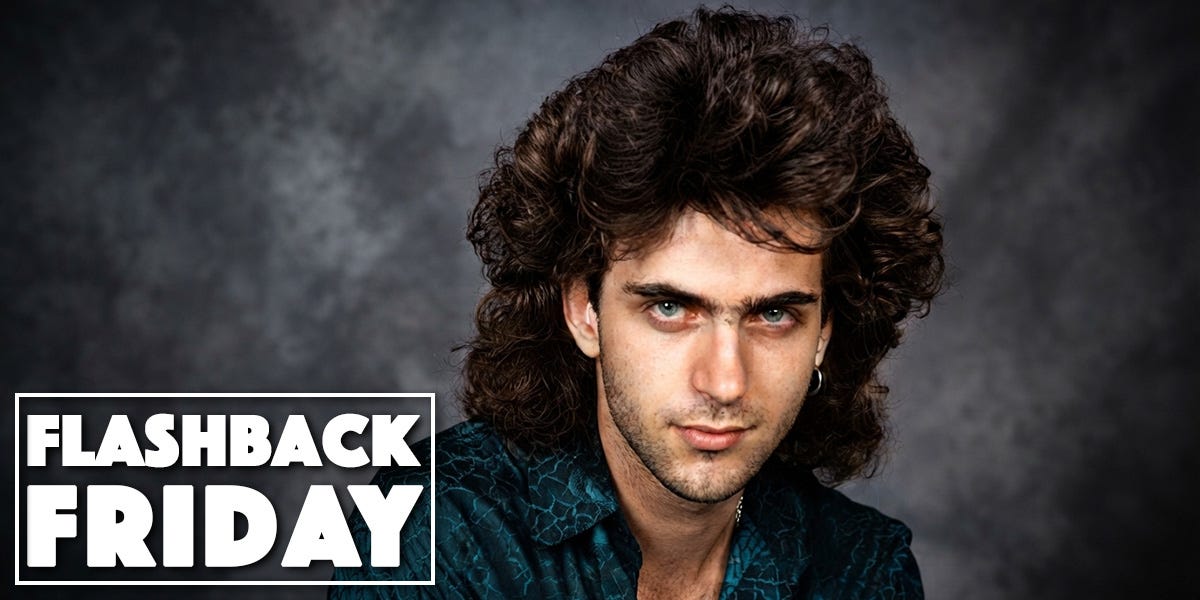
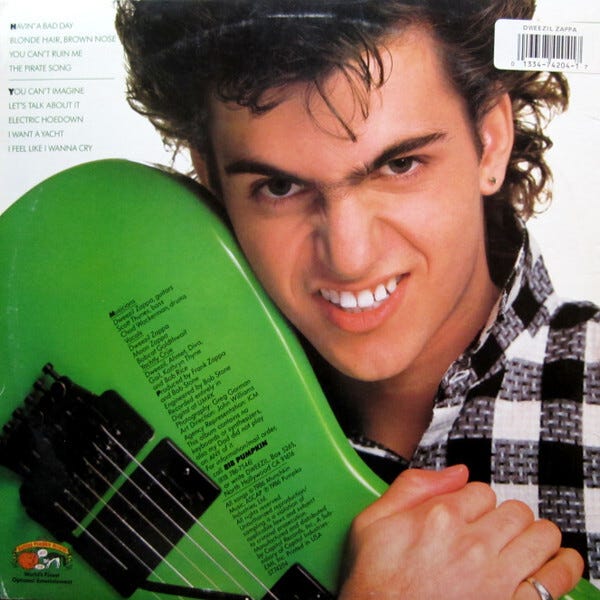
Forty years. Let that sink in. It has been four decades since a teenage shredder named Dweezil Zappa unleashed his debut solo album, Havin’ A Bad Day, in the summer of 1986. Looking back from 2026, it is easy to chuckle at the neon-soaked, hair-sprayed aesthetics of the mid-80s, but this record remains a fascinating milestone.
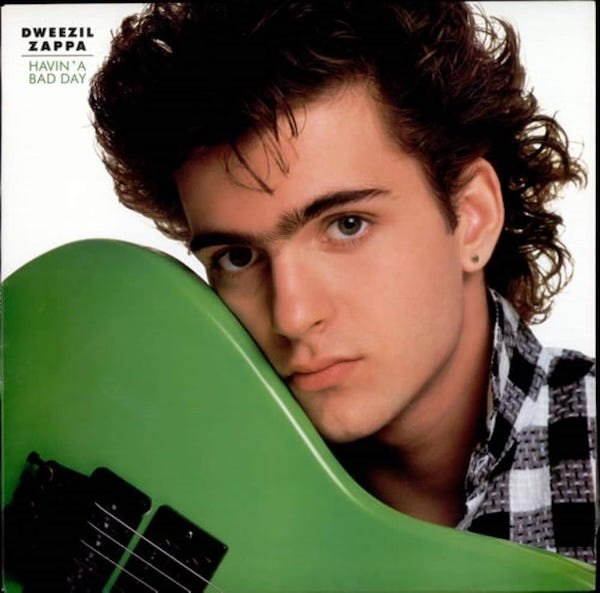
At just sixteen years old, Dweezil was caught in the ultimate cultural crossfire: on one hand, he was a regular SoCal kid obsessed with heavy metal guitars and players who showcased that style, yet on the other, his last name carried the heavy, avant-garde intellectual weight of his legendary guitar-maestro father, Frank Zappa.
To his credit, Frank didn’t discourage Dweezil’s obsession with the flashy, neon-soaked shredders of the 1980s (like Eddie Van Halen and Randy Rhoads)—in fact, he actively supported it.
Working under his father’s roof meant Dweezil was absorbing world-class production standards and discipline by osmosis. Frank created an environment where experimentation, humor, and technical ambition were rewarded, even if the genre of choice was teenage heavy metal rather than twentieth-century orchestral composition.
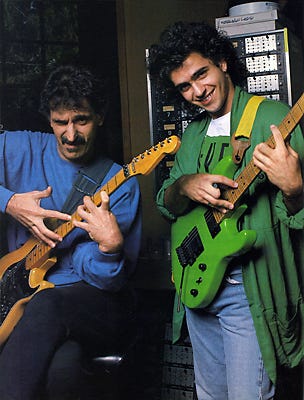
That dynamic laid the groundwork for everything. Frank gave Dweezil the tools, the studio, and the safety net to fail or succeed on his own terms—ultimately forging the confidence a kid needed to survive the music business and, decades later, carry the Zappa torch.
In 1986, Havin’ A Bad Day served as Dweezil’s official musical emancipation proclamation. While most teenagers were stressing over geometry finals or trying to pass their driver’s test, Dweezil was hanging out in the Utility Muffin Research Kitchen (UMRK), Frank’s state-of-the-art home studio, trading licks with the various guitar gods who just happened to pop over to visit his dad in the storied LA neighborhood of Laurel Canyon.
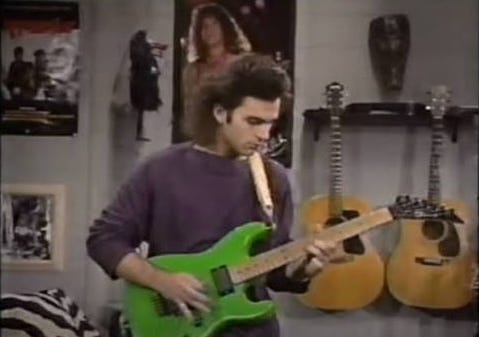
For young Dweezil tho, the album was a high-stakes, high-wire act. It was an opportunity to prove he wasn’t just coasting on nepotism—even though his dad literally helped produce the record alongside engineer Bob Stone and also offered up two members of his touring rhythm section to play on the record as well (Chad Wackerman on drums and bassist Scott Thunes)! It successfully bridged the gap between youthful, MTV-era mischief and genuine, jaw-dropping technical ambition.
The rock landscape at the time was locked in a fierce turf war. On one front, hair metal was taking over MTV, dominated by polished acts like Bon Jovi, Poison, Mötley Crüe and Ratt. On the other hand, the neoclassical shred revolution was in full swing, spearheaded by guitar warlords like Yngwie Malmsteen.
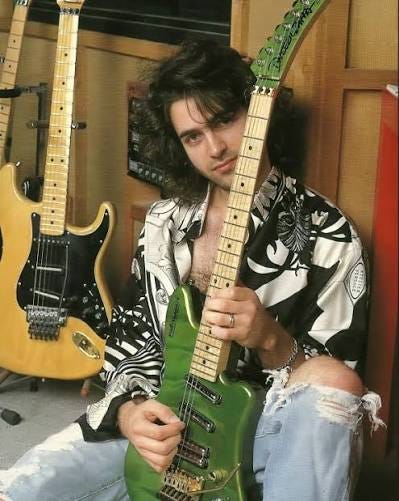
Havin’ A Bad Day threw its fluorescent-green hat directly into the shred ring. Culturally, it stood as a wonderful paradox: it had all the requisite guitar worship, humorous song titles (“Blonde Hair, Brown Nose”), and tongue-in-cheek artwork, but it was injected with a distinctly Zappa-esque sense of irreverence that kept it from taking itself too seriously.
When the record dropped, the reactions were predictably polarized. Traditional rock critics were often perplexed. Some wondered why a Zappa offspring was dabbling in straight-ahead 80s hard rock and heavy metal rather than crafting dense, orchestral avant-garde suites. Others, however, appreciated the self-aware humor and undeniable fretboard fireworks.
Alternatively, and most importantly, young rock fans and aspiring guitar nerds absolutely ate it up. They found a kindred spirit in Dweezil—someone who loved blazing riffs, classic cartoons, and making noise just for the sheer joy of it.
Beneath the hairspray and the heavy metal bluster, the album’s songs reveal a clever blend of shredder worship and humorous lyrics, but the songs that really stood out showcased a more melodic, pop-sensibility.
The title track “Havin’ A Bad Day” kicks things off like a shot of pure caffeine straight to the fretboard. Co-written with bassist Scott Thunes, it sets the blueprint for the whole record: lightning-fast neoclassical riffs crashing headfirst into self-deprecating humor. It’s impossible not to smile when a sixteen-year-old shreds at the speed of light while complaining about life’s minor inconveniences.
For anyone wondering if Dweezil could hang purely on musical merit without relying on gimmicks, the instrumental track “The Pirate Song” was the definitive answer. Backed by Chad Wackerman’s intricate, shifting drum patterns and Thunes’ prowling bass, Dweezil navigates a maze of complex time signatures and soaring, melodic metal leads. It’s a brilliant nod to his dad’s complex compositional style, disguised as a swashbuckling 80s guitar clinic.
A refreshing detour into melodic territory, “Let’s Talk About It” highlights the collaborative family spirit of the album. With Moon Zappa on lead vocals, the song trades total thrash-metal aggression for a sleek, driving rhythm and an instantly memorable central riff. Dweezil still manages to sneak in a blistering guitar solo, but the track proves he had a sharp ear for catchy 80s songwriting hooks.
Finally, “I Want A Yacht” takes the crown for the ultimate 80s family-and-friends musical comedy event. Alongside Dweezil’s swaggering lead vocals, the song features backing harmonies from the “Yachtly Crüe” (comprising the entire Zappa clan) and unhinged, screaming voiceover cameos from legendary stand-up comic Bobcat Goldthwait. It’s chaotic, loud, and delightfully unhinged—proving that the Zappa family often treated recording sessions like an open-mic comedy night with a really good house band.
Looking back four decades later, Havin’ A Bad Day holds up as a charming, lightning-fast time capsule of 1986 youth culture. It proved that Dweezil had the technical chops to survive in the shark-infested waters of the music industry long before he eventually grew into the masterful torchbearer of his father’s catalog. It wasn’t high art, and it certainly didn’t pretend to be—but it was a loud, fun, and unpretentious good time.
The Album
(Not available on streaming services so this is the best I could do)
The Song
Music Video Premiere on MTV:
The Band
Be sure to check out the Audio Toxicity 2026 Bad Music Detox Protocol (AKA a playlist of songs covered so far…)